NPT Review Ends Without Consensus, Leaving Nuclear Bargain More Exposed


By: Ahmed Fathi
UNHQ, New York: The 11th NPT Review Conference of the Treaty on the Non-Proliferation of Nuclear Weapons wrapped up at the United Nations without reaching consensus on a final document, ending four weeks of diplomacy with another reminder that the world’s main nuclear treaty is still standing but increasingly strained.
The conference, held in New York from April 27 to May 22, was meant to assess the health of the NPT, a treaty built on a straightforward deal: nations without nuclear weapons agree not to develop them, those with nuclear weapons commit to disarmament, and all nations can access peaceful nuclear energy under safeguards. In theory, it’s still one of the most important agreements in modern international security. But the 2026 review showed just how hard it’s become to uphold that deal when trust is low, wars are ongoing, and some states see nuclear weapons more as safety nets than as dangers to eliminate.
The outcome was clear: no deal. Delegates couldn’t agree, even on a watered-down draft, as announced by the conference chaired by Viet Nam’s Ambassador Do Hung Viet. He told the Associated Press that no single country blocked consensus, but a major sticking point was language declaring Iran “can never seek, develop, or acquire any nuclear weapons.” That line turned into more than just a technical issue—it became the flashpoint for the conference’s larger political rifts.
Iran bristled at being singled out, while the U.S. and others pushed for stronger wording on Iran’s nuclear obligations, transparency, enrichment, and cooperation with the International Atomic Energy Agency. Iran, in turn, pointed to attacks on its nuclear sites and accused Washington and Israel of violating international law and undermining the very deal they claimed to support. Predictable, maybe, but still a blow: the conference couldn’t bridge the gap between holding all parties accountable and applying accountability selectively.
It was not only Iran." Iran was never the complete fire, only the spark. The more fundamental problem is that the NPT presently has too many unsolved crises simultaneously. The war in Ukraine and the dangers near nuclear sites, especially Zaporizhzhia, played a role in derailing the 2022 review conference.
Meanwhile, the unresolved 1995 agreement for a zone free of nuclear and other weapons of mass destruction remains a major issue in the Middle East. AUKUS still triggers worries concerning naval nuclear propulsion and safeguards. North Korea is still not part of the pact with nuclear weapons. China’s nuclear expansion, the collapse of U.S.-Russia arms control, and modernization by all nuclear-armed states have eroded confidence that disarmament is progressing in any significant direction.
This is why this failure matters. It’s now the third consecutive NPT review conference to fall short, after 2015 and 2022, and there hasn’t been a final consensus document since 2010. A failed meeting doesn’t mean the treaty is collapsing, but it does show the review process is losing credibility. Diplomats can say the NPT is still the cornerstone of the global nuclear system, and technically they’re right—but even a cornerstone can crack before the building falls.
The major takeaway from the meeting is the rising frustration among non-nuclear states. Many feel there’s a clear double standard: they’re expected to obey the rules, accept inspections, and avoid nuclear weapons, while nuclear-armed nations upgrade their arsenals, expand deterrence strategies, and delay disarmament. Groups like ICAN have called out the absence of a realistic plan, with nuclear states resisting stronger commitments. That criticism will likely strike a chord with non-nuclear governments, especially those who think the treaty now leans too heavily toward protecting nuclear privilege.
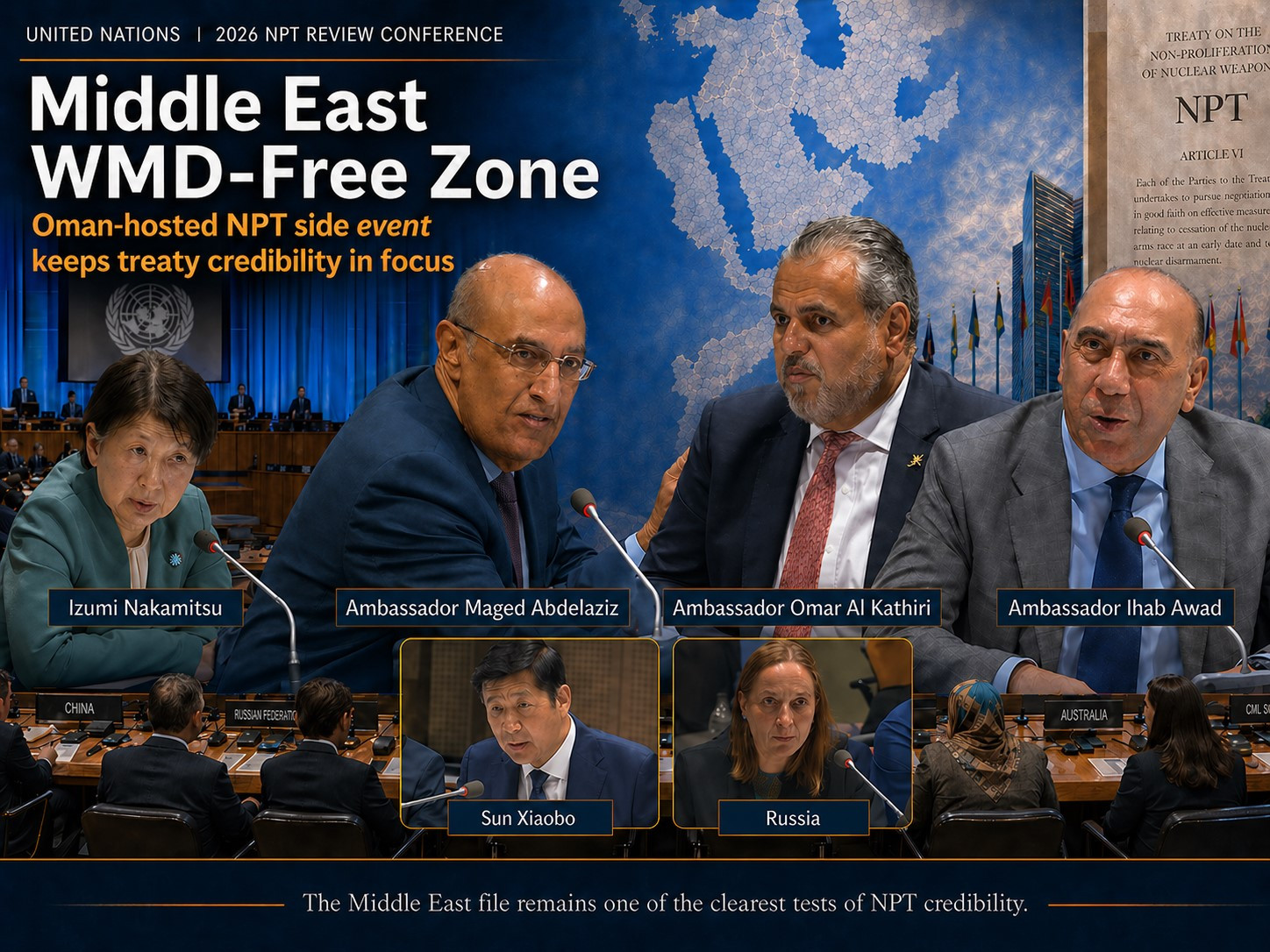
For the Arab Group, the result also leaves the Middle East issue unaddressed. The 1995 resolution on the Middle East was not a side issue. It was all part of the political package that allowed the NPT to extend forever. Almost three decades later, the area still lacks a nuclear-weapon-free zone, a WMD-free zone, and an agreed-upon regional security framework that would include Israel. The annual U.N.-mandated conference process on a nuclear-weapon-free and other WMD-free Middle East zone continues, but the 2026 NPT review did not provide the kind of unanimous endorsement that Arab governments had hoped for. This situation will further increase the perception that the NPT is asking the area to be patient without any of the political dividends it promised.
The summit also sharpened the attention on another issue: attacks on nuclear facilities. This is no longer a technical safety issue. It is now a fundamental non-proliferation issue. Military activity near nuclear facilities in Ukraine or Iran raises concerns that the NPT system was never designed to deal with so simply. The promise of peaceful nuclear energy becomes far more difficult to protect if nuclear sites become normal targets in battle.
Meanwhile, AUKUS did not break up the summit, but it remains a key point of contention for the future of the Indo-Pacific. The transfer of nuclear-powered submarine technology to a non-nuclear-weapon state presents complex considerations concerning safeguards, precedence, and confidence. Australia says it will remain fully compliant with the NPT. China and others perceive a worrisome loophole. This problem is not going to go away. It may be more relevant in the future review cycle.
The third lesson is a tough one but an important one: the NPT still has relevance since almost every country stays inside it, but the underlying political bargain is coming under increasing strain. The treaty remains in effect because the alternative is worse. But experiencing it is not the same as being healthy.
The 2026 Review Conference did not kill the NPT. It showed the chasm between diplomatic phrases and strategic reality. States still laud the deal in speeches, but many behave as if nuclear weapons are becoming more valuable, not less. That’s the contradiction at the heart of the crisis.
The easiest way to read the conclusion is as follows: the NPT is still alive, but trust surrounding it is fading. The world did not leave New York with a more robust nuclear order. It left with another warning: that unless disarmament, non-proliferation, and regional security are seen as related obligations, not just selective talking points, the treaty’s next review may face an even tougher question—not whether states can agree on a document, but whether they still believe in the bargain behind it.