
Kazakhstan Brings a Nuclear-Free Success Story to the U.N., but the Middle East Remains the Hard Question

By Ahmed Fathi
UNHQ, New York — At a U.N. conference dominated by warnings of nuclear danger, Kazakhstan brought a different message: one region chose nuclear restraint and made it last. That message came Tuesday at a side event marking the 20th anniversary of the Central Asia Nuclear-Weapon-Free Zone, created by the Treaty of Semipalatinsk. Held during the 2026 NPT Review Conference, the event examined whether nuclear-weapon-free zones can still offer security value as nuclear risks rise again.
Moderated by Olamide Samuel of the Open Nuclear Network, the meeting was jointly organized by the Permanent Mission of Kazakhstan, the U.N. Office for Disarmament Affairs, UNIDIR and the Nuclear Threat Initiative. Its more profound question was whether regional nuclear restraint can survive in a harsher security age.
For Kazakhstan, the answer begins with Semipalatinsk.

Yerzhan Ashikbayev, Kazakhstan’s First Deputy Minister of Foreign Affairs, framed the anniversary as a reminder of a “deliberate strategic choice” by Central Asian states to pursue security through transparency, cooperation, and trust rather than nuclear deterrence. He said the zone had shown that security without nuclear weapons was “not only possible, but also sustainable.”
The Treaty of Semipalatinsk is named after a place where Soviet nuclear testing left consequences that outlived the Cold War. For Kazakhstan, the zone is an answer to a historic wound.

Chris King, chief of the Weapons of Mass Destruction Branch at the U.N. Office for Disarmament Affairs, called the zones “living instruments” of regional security, nonproliferation, and nuclear risk reduction. But he warned that their status remains uneven, with some protocols unsigned or unratified by nuclear-weapon states and some security assurances carrying reservations.

Maria Cecilia Barcelos Cavalcante Vieira of Brazil, chair of the U.N.-mandated Qualified Group of Experts preparing a new study on nuclear-weapon-free zones, said a new assessment was needed because 50 years had passed since the first major U.N. study. The question now is whether the zones can still be relevant in a more dangerous world.

Robin Geiss, director of UNIDIR, said nuclear-weapon-free zones are evolutionary by design. He said the Central Asian zone made a distinct contribution by connecting security with development, environmental protection, and public health.

Mark Melamed of the Nuclear Threat Initiative said the zones remain one of the NPT’s success stories but warned that their achievements should not be assumed to last.

Sara Opatovsky of UNIDIR presented the new Nuclear-Weapon-Free Zones Hub, a digital platform to map and compare existing zones.
Several states also entered the discussion.

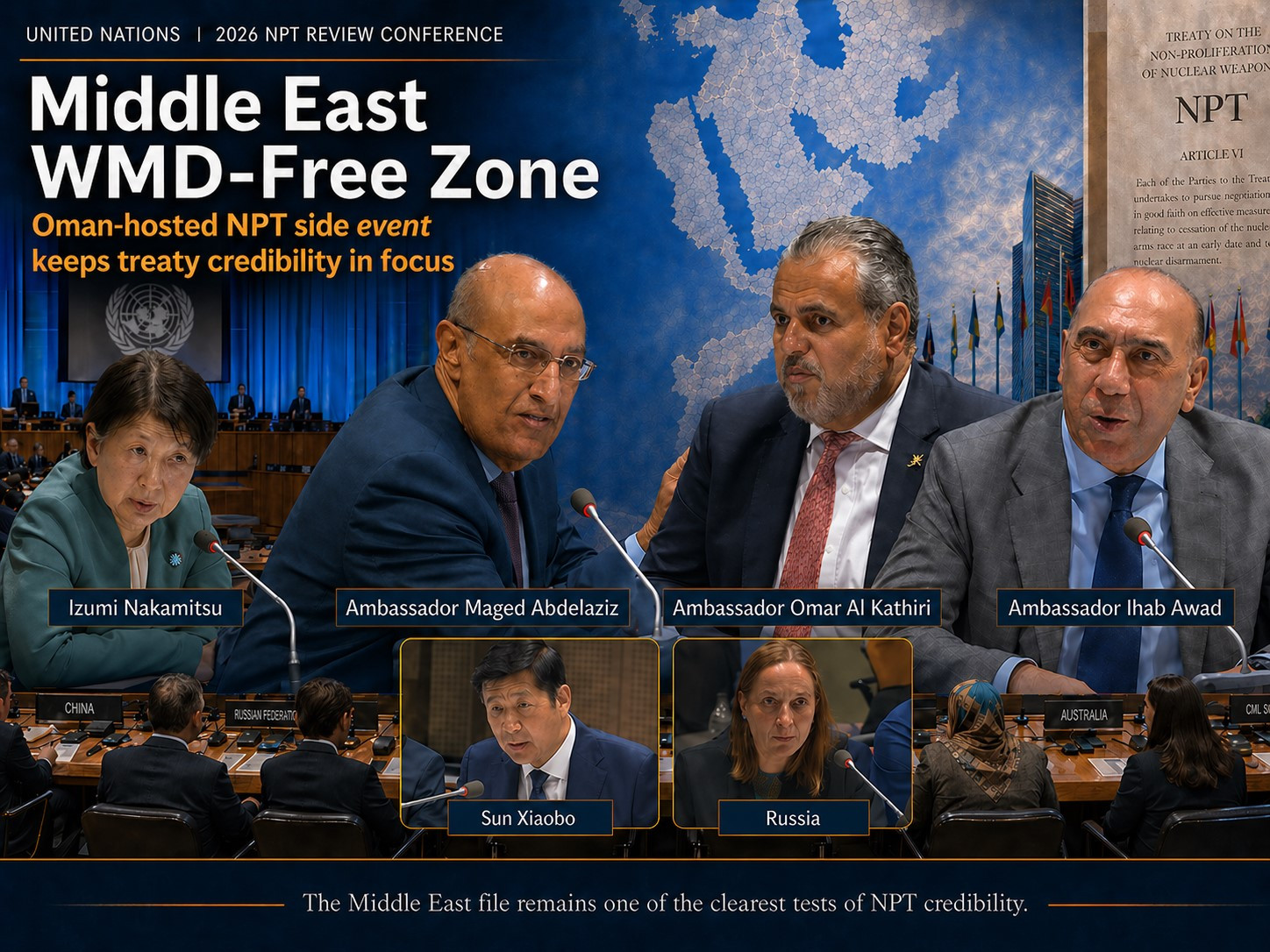
Sun Xiaobo, Head of China’s delegation to the 2026 NPT Review Conference, said Beijing supports nuclear-weapon-free zones based on regional initiative and free will and has signed and ratified all protocols open to nuclear-weapon states.

Ambassador Aida Kasymalieva, Permanent Representative of Kyrgyzstan to the United Nations, said the Central Asian treaty had turned a bold dream into reality. Speaking as depositary of the Treaty of Semipalatinsk, she said four of the five nuclear-weapon states had ratified the protocol providing security assurances to Central Asian states and called on the remaining state to complete the process.

Mikhail Kondratenkov, Head of Russia’s delegation to the 2026 NPT Review Conference, said Moscow supports nuclear-weapon-free zones and referred to Russia’s participation in efforts toward a Middle East zone free of nuclear weapons and other weapons of mass destruction.
Then the event turned from commemoration to transferability.

The panelists did not offer a simple formula in response to my question about what lessons from 20 years of the Semipalatinsk Treaty could apply to future nuclear-weapon-free zone negotiations, particularly regarding the stalled Middle East WMD-free zone process.
Vieira said the Middle East is a specific case because it is linked to a U.N. resolution and concerns weapons of mass destruction, not only nuclear weapons. Ashikbayev said Kazakhstan’s path was shaped by the tragedy of Semipalatinsk, the Nevada-Semipalatinsk anti-nuclear movement, the closure of the test site in 1991 and regional cooperation around nonproliferation.
King said that each nuclear-weapon-free zone emerged from its conditions. Latin America’s treaty came after the Cuban missile crisis. Nuclear testing shaped the South Pacific and Central Asia. Successful zones usually emerge when states identify a shared danger or memory strong enough to become policy.
That distinction is relevant for the Middle East. The region has active wars, deep mistrust, Israel’s undeclared nuclear capability, Iran’s nuclear file, rival security doctrines, and external powers embedded in its conflicts. The proposed Middle East zone is more complex because it seeks a region free of all weapons of mass destruction, not only nuclear weapons.
Central Asia’s lesson is powerful, but not portable in a suitcase. Semipalatinsk worked because memory, political will, and regional ownership aligned around a shared understanding of nuclear harm.
Kazakhstan offered evidence that nuclear restraint can be built and sustained. The Middle East remains the harder test: what happens when people share danger but do not trust each other?
NPT 2026 Review Conference Series


- NPT Review Ends Without Consensus, Leaving Nuclear Bargain More Exposed (To Publish on May 28th, 2026)