
Oman Leads NPT Push as Arab Diplomats Keep Middle East WMD-Free Zone in Focus


By Ahmed Fathi
UNHQ, New York: The long-stalled effort to establish a Middle East zone free of nuclear weapons and other weapons of mass destruction returned to the center of the NPT debate Wednesday, as diplomats warned that the issue remains inseparable from the credibility of the nuclear non-proliferation regime itself.
At a side event hosted by Oman during the 11th Review Conference of the Treaty on the Non-Proliferation of Nuclear Weapons, speakers described the zone not as a distant diplomatic aspiration but as an unfinished political commitment based on the 1995 bargain that allowed the NPT’s indefinite extension.
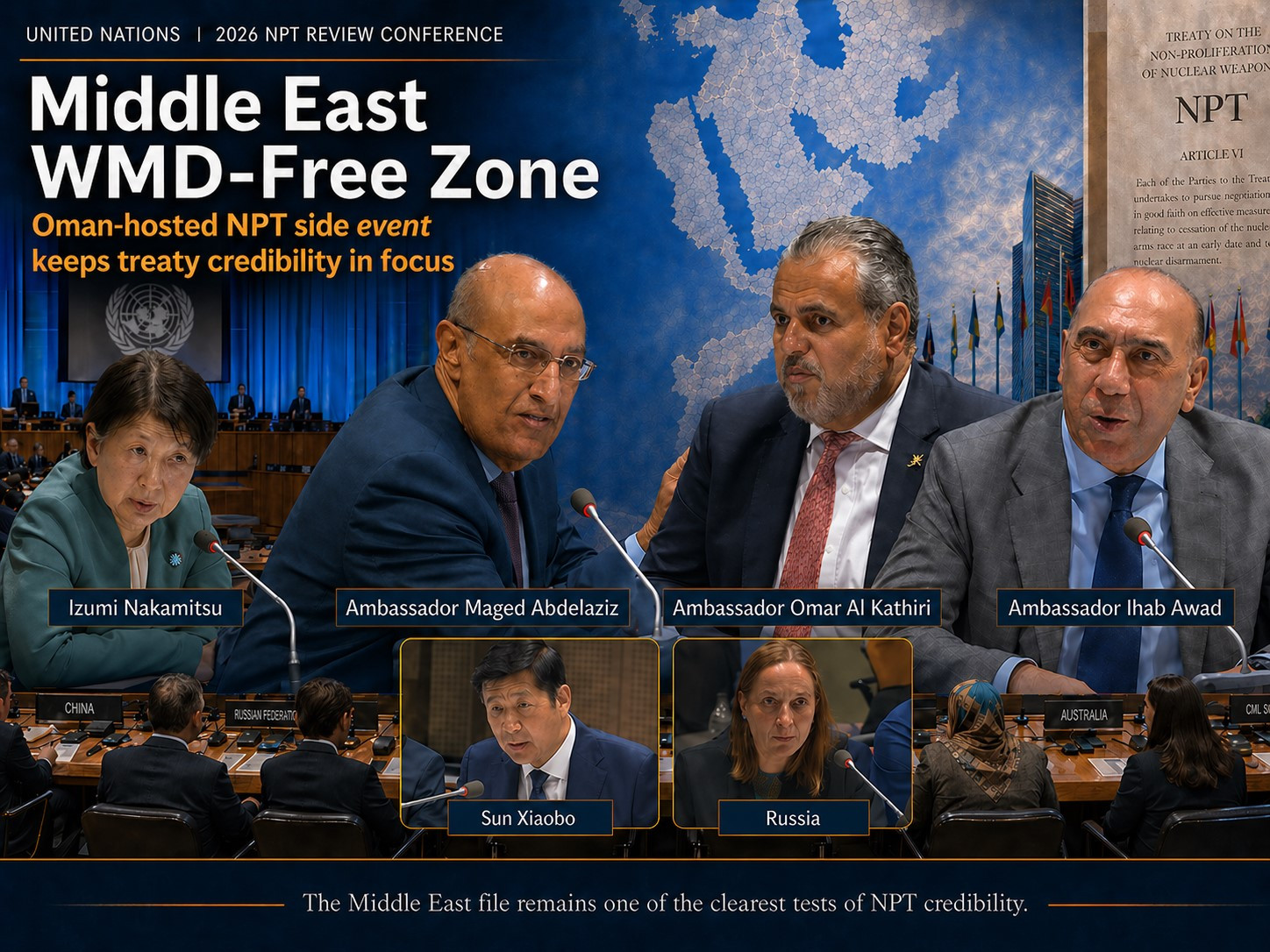
The event, titled “Progress and Prospects for the Conference on the Establishment of a Middle East Zone Free of Nuclear Weapons and Other Weapons of Mass Destruction,” brought together U.N. disarmament officials, Arab diplomats, China, Russia, South Africa, Australia, and civil society voices. But the sharpest intervention came from Ambassador Maged Abdelaziz, Permanent Observer of the League of Arab States to the United Nations, who laid out the political problem with unusual candor.
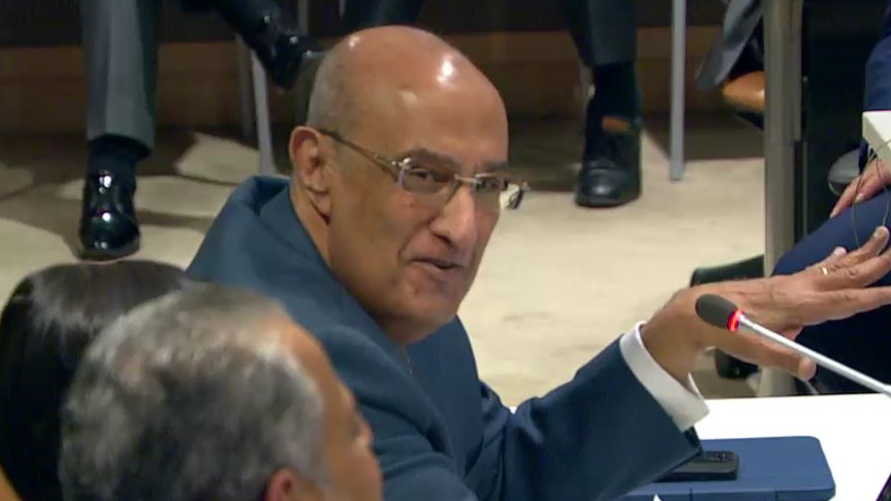
Abdelaziz said the process faces a basic dilemma: one regional state, Israel, does not attend, and one major observer, the United States, also stays away. That absence, he said, raises a difficult question for Arab states and other regional participants: whether they can negotiate a treaty among themselves and leave the door open for Israel to join later, or whether Israel’s absence will continue to block the process altogether.
His intervention went beyond the familiar diplomatic language that often surrounds the issue. Speaking as a veteran of NPT diplomacy, Abdelaziz warned that the Middle East file is at risk of being pushed into a procedural corner. He said some NPT members now appear to treat the U.N. General Assembly-mandated conference process as a substitute for action inside the NPT itself.
Arab states moved the issue to the General Assembly after the failure to convene the 2012 conference called for by the 2010 NPT Review Conference. But Abdelaziz said that shift did not remove the Middle East issue from the NPT framework. The 1995 Middle East resolution, he argued, remains a continuing obligation and should be included in NPT outcome documents, subsidiary bodies, and review conference discussions until its goals are met.
His remarks reflected a wider Arab concern: that the separate U.N. conference process may be used by some states to quietly delink the Middle East zone from the original NPT bargain. In plain English, the fear is that someone will move the issue to another room and then politely forget about it.
Abdelaziz also raised another difficult question: how the future treaty would relate to the five nuclear-weapon states and what kind of protocols could realistically be negotiated with them at a moment of deep geopolitical division. He noted that the five nuclear-weapon states are not even meeting with the same level of cohesion seen in previous NPT cycles, making any collective protocol negotiation more difficult.
He also warned that U.N. budget pressures and the broader UN80 reform process could affect the conference’s ability to continue its work. For a process already struggling against political absence and regional mistrust, the possibility of shrinking institutional support adds another quiet but serious risk.

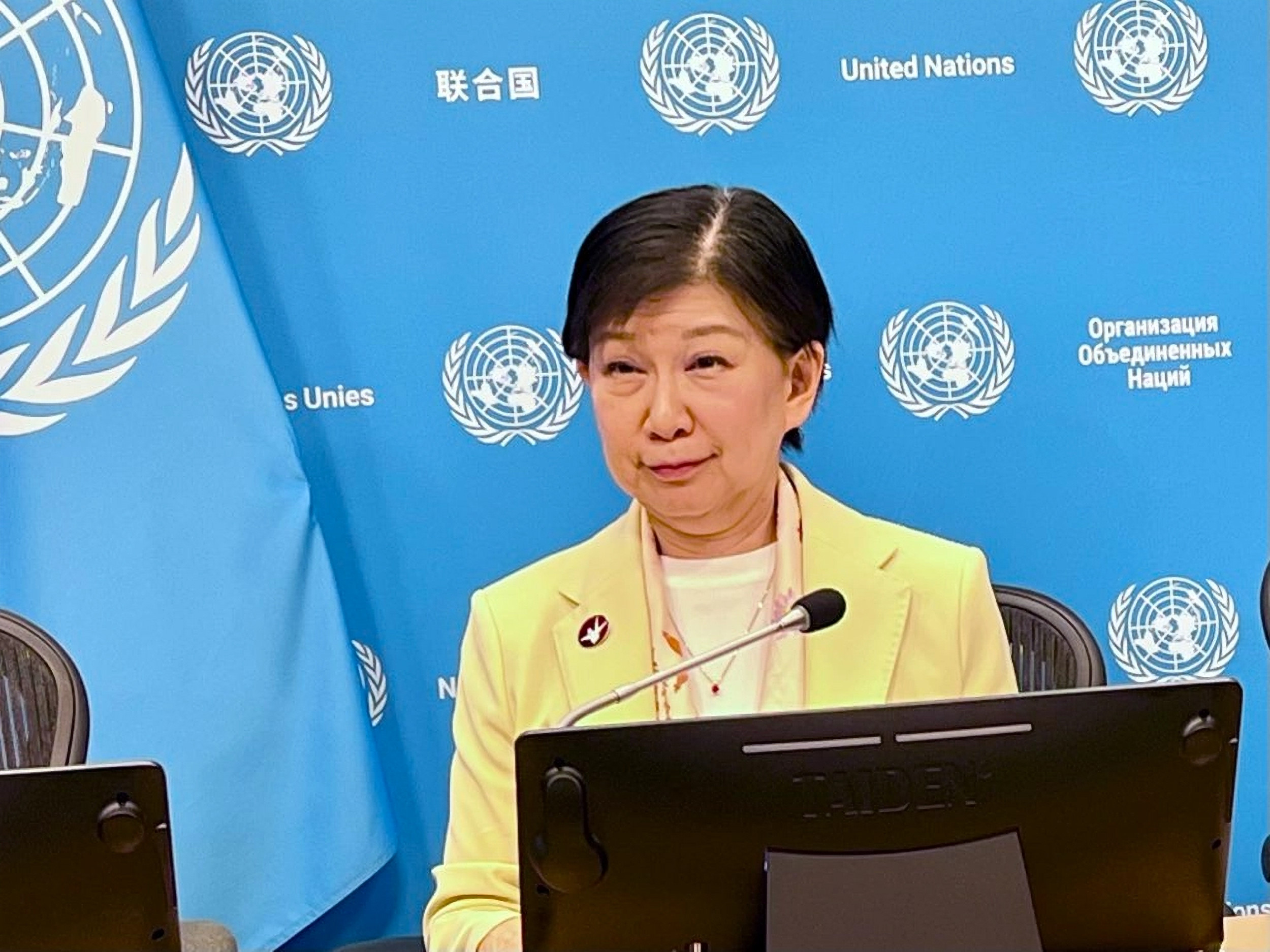
Izumi Nakamitsu, U.N. High Representative for Disarmament Affairs, gave the institutional framing for that concern. She recalled that efforts to establish such a zone go back decades, including a 1974 General Assembly resolution co-sponsored by Egypt and Iran and the 1995 NPT Review and Extension Conference, where the Middle East resolution became part of the package that allowed the treaty to be extended indefinitely.
Nakamitsu said full implementation of the 1995 resolution remains linked to the “credibility and integrity” of the NPT and carries profound significance for peace and security in the Middle East. She said the conference process launched by the General Assembly in 2019 had, for the first time, created a dedicated multilateral platform where regional states could engage in structured and sustained dialogue.
Still, she acknowledged the obstacles. The regional security context remains fragile, divisions persist, trust has eroded, and not all regional states have yet fully participated. But she said the value of the process lies precisely in preserving a diplomatic space where political and technical issues can continue to be discussed, even amid recurrent crises.

Oman’s Ambassador Omar Al Kathiri, as president of the seventh session of the zone conference, sought to present the process practically rather than symbolically. He said the creation of a Middle East zone free of nuclear weapons and other weapons of mass destruction is not only an aspirational objective but also a “pressing strategic priority” consistent with the NPT framework and the 1995 resolution.
Oman said the conference process had made gradual progress despite persistent challenges and should now move toward “practical and incremental results.” Under Oman’s presidency, he said, the Working Committee would hold thematic meetings in the region on issues including chemical and biological weapons obligations, declarations, institutional arrangements, and links with relevant international conventions.

Egypt’s Ambassador Ihab Awad reinforced the Arab legal and diplomatic position, stressing the complementarity between the U.N. conference process and the NPT. He warned that when NPT review conferences hit a roadblock over language on the 1995 resolution, some states try to use the separate conference process as a substitute.
Awad said the conference should facilitate the NPT process, not replace it. Any future legally binding treaty establishing the zone, he argued, must be integrated into the NPT regime if it is to carry the political weight it deserves.

China’s head of delegation, Sun Xiaobo, used the event to connect the Middle East zone to recent concerns over attacks on nuclear facilities. He said military strikes against a sovereign NPT state party and nuclear facilities under IAEA safeguards, without Security Council authorization, set a dangerous precedent for resolving non-proliferation disputes by force. He called on Israel to join the NPT as a non-nuclear-weapon state and said the Iranian nuclear issue could only be resolved through political and diplomatic means.

A Russian representative also reaffirmed Moscow’s support for the zone, saying the 1995 resolution remains valid until implemented. Russia criticized Israel and the United States for not participating in the conference process and said the current deterioration in regional security makes the zone more urgent.

South Africa offered one of the most practical interventions of the session. Drawing on the African nuclear-weapon-free zone experience, Sahib Mohamed said treaty negotiations in Africa began when South Africa, then the key nuclear-capable state on the continent, was not initially at the table. Negotiators nevertheless built a framework that allowed South Africa to join later after it dismantled its nuclear weapons program and accepted safeguards.
That precedent appeared to answer, at least partly, the question raised by Abdelaziz: whether a regional treaty process can begin without the participation of the most difficult state. South Africa’s message was cautious but clear: absence does not have to mean paralysis.
Qatar, Saudi Arabia, Australia, and civil society representatives also voiced support for continued dialogue. Saudi Arabia said implementation of the 1995 Middle East resolution is a collective international responsibility, especially for the states that sponsored it. Australia supported the right of states in the region to freely establish further nuclear-weapon-free zones. Civil society speakers urged more attention to technical verification, expert training, and the underlying conflicts that feed regional insecurity.
The event ended without a breakthrough, but that was never the real test. Its significance lay in the political signal: Arab states and their supporters are determined to keep the Middle East WMD-free zone process inside the NPT conversation, not as a side issue but as a measure of whether the treaty’s old bargain still means what it says.
That is where the Middle East remains the hardest test.
The region does not lack danger. It has too much of it: active wars, collapsing trust, Israel’s undeclared nuclear capability, Iran’s contested nuclear file, rival security doctrines, and external powers embedded in nearly every major crisis. Unlike existing nuclear-weapon-free zones, the proposed Middle East arrangement also seeks to cover all weapons of mass destruction, not nuclear weapons alone.
That makes the project more difficult, but not less necessary. The lesson from other nuclear-weapon-free zones is not that one region can copy another’s path. It is that restraint becomes possible when states identify a shared danger strong enough to become policy.
For now, the Middle East has the shared danger. What it does not yet have is shared trust.
For the 2026 NPT Review Conference, that means the Middle East file is not background noise. It is one of the places where the treaty’s credibility will be judged and where the gap between diplomatic promises and regional reality will be hardest to hide.
NPT 2026 Review Conference Series


- NPT Review Ends Without Consensus, Leaving Nuclear Bargain More Exposed (To Publish on May 28th, 2026)