
UN Security Council Hears Stark Accounts of Iran Crackdown as U.S. Warns ‘All Options Are on the Table’
Updated: Jan 16

By ATN News Team
UNHQ, New York: The U.N. Security Council convened an emergency session Thursday on Iran, hearing harrowing testimony from dissidents who said they were tortured and targeted for assassination, as the United States warned Tehran that “all options are on the table to stop the slaughter” and major powers clashed over whether the meeting itself risked escalating the crisis.
The meeting, requested by Washington, came amid weeks of nationwide protests in Iran sparked by economic collapse, inflation and currency depreciation, followed by what multiple speakers described as a sweeping security crackdown and near-total communications blackout. The session quickly became one of the most politically charged Council debates of the year, blending raw personal testimony with explicit geopolitical signaling.

Masih Alinejad, an Iranian journalist and political dissident, told the Council that millions of Iranians need “real and concrete action” against a regime that “does not understand the language of diplomacy.” She described a total blackout — “no Internet, no cell phones and no landlines” — adding, “Iran is in total darkness.” Challenging the U.N.’s leadership directly, she asked: “Why are you afraid of the Islamic Republic?” She said demonstrators were demanding that public funds “stop being stolen and sent to Hamas, Hizbullah and the Houthis,” while authorities responded with force, including the use of AK-47s.
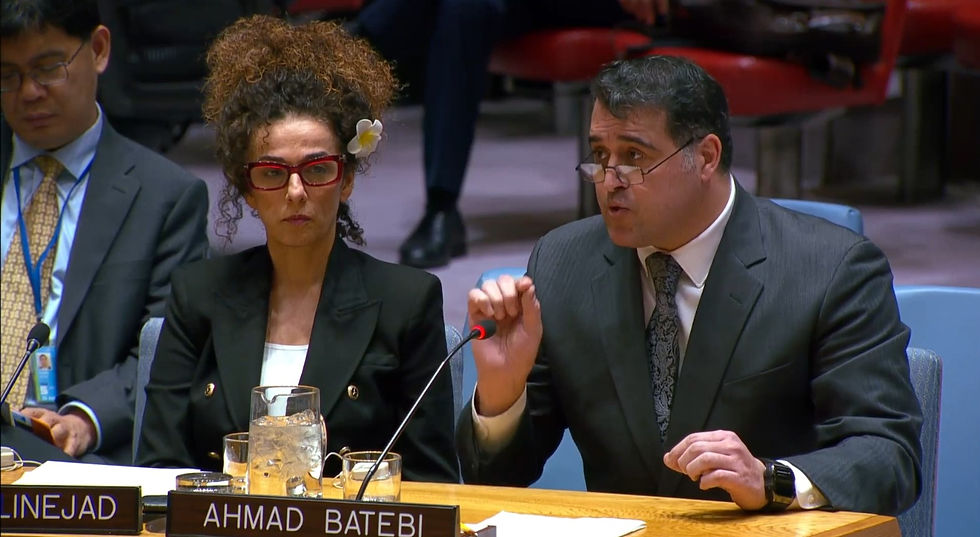
Ahmad Batebi, Iranian American journalist and human rights activist, recounted being arrested as a student protester, sentenced to death, held in solitary confinement and subjected to torture and mock executions. “When you fight with our regime, it means you fight with God… and your punishment is death,” he said. Addressing Iran’s representative directly, he added: “You tried to kill me, but you couldn’t… you cannot kill all the people.” He appealed to U.S. President Donald Trump: “You encouraged them, and they are in the street… don’t leave them alone.”

Speaking for the United Nations Secretary-General, Assistant Secretary-General Martha Pobee warned that “the situation in Iran is fluid and deeply concerning,” noting that protests continue and that the communications blackout remains largely in place. She cautioned that public statements suggesting possible military strikes add a dangerous external dimension. “This external dimension adds volatility to an already combustible situation,” she said, urging maximum restraint and renewed focus on diplomacy.

U.S. Ambassador Mike Waltz said the violence unleashed by Tehran against its own population “has repercussions for international peace and security,” and thanked the briefers for their courage, noting that both had been “personally targeted for assassination” and tortured. “President Donald J. Trump and the United States of America stands by the brave people of Iran,” he said, adding that the regime “will be held accountable.” Earlier, U.S. officials stressed that “all options are on the table to stop the slaughter.”

Iran’s Deputy Permanent Representative, Ambassador Gholamhossein Darzi, rejected the testimony and accused Washington of manipulating the session. He said the briefers “represent the political agenda of the United States and Israeli regimes” and warned that any threat or use of force against Iran would be illegal. “Any threat to use force… would constitute a grave violation of international law and the UN Charter,” he said, citing Articles 2(4) and 2(7). “Iran seeks neither escalation nor confrontation,” he added, but warned: “Any act of aggression… will be met with a decisive, proportionate and lawful response under Article 51 of the Charter.”

Russia’s Ambassador Vassily Nebenzia accused Washington of “fueling hysteria” around Iran and said the meeting was “nothing more than yet another attempt to justify blatant aggression and interference in the internal affairs of a sovereign State.” China’s Ambassador Sun Lei said the United States had shown an “obsession” with the use of force, stressing that “the use of force can never solve problems” and warning that military adventurism would push the region “towards an abyss.”
Several elected members focused on the human rights dimension. U.K. Ambassador Archibald Young said Britain was “appalled” by reports that potentially thousands had been killed. “We pay tribute to the courage of the Iranian people, particularly Iranian women,” he said.

Colombia’s Ambassador Leonor Zalabata Torres warned that repression has a disproportionate impact on women and called for the restoration of internet access and protection for journalists. Pakistan’s Ambassador Asim Iftikhar Ahmad urged that disputes be resolved “through peaceful means” and rejected any external interference.
Moments that defined the session
• Alinejad’s direct challenge to the U.N.: “Why are you afraid of the Islamic Republic?”
• Batebi’s blunt message to Tehran: “You cannot kill all the people.”
• The U.S. doubling down: “All options are on the table.”
• Iran’s legal warning: invoking Articles 2(4), 2(7) and 51 of the Charter.
• Sharp Russia–China alignment against what they called Western escalation.
By the time the Council president closed the meeting, the diplomatic divide was unmistakable: raw testimony versus sovereignty arguments, human rights urgency versus warnings of war — and a chamber left wrestling with whether it is witnessing the beginning of de-escalation efforts or the opening act of a far more dangerous phase.