
U.S., Israel and Iran Clash at UN Security Council as War Fears Grow

By ATN News Team
UNHQ, New York: The United Nations Security Council convened an emergency session Saturday as the Middle East crisis sharply escalated following U.S. and Israeli military strikes on Iran and Tehran’s retaliatory attacks across the region.
The meeting, requested by several Council members amid rapidly rising tensions, quickly turned into a diplomatic confrontation between Washington and Tehran, with major powers divided over the legality of the strikes and the risk of a wider regional war.
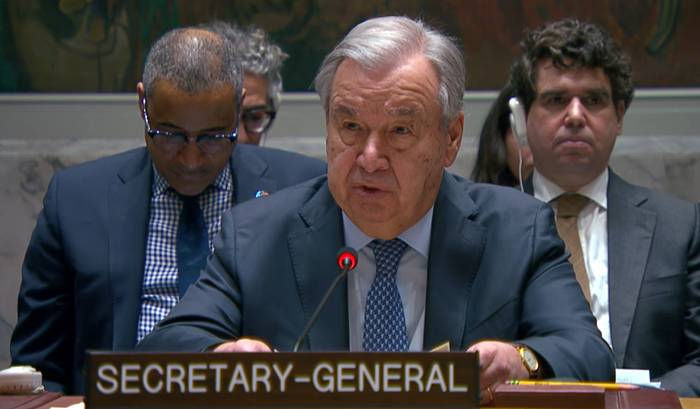
UN Secretary-General António Guterres opened the session with a stark warning. The military actions by all sides, he said, are pushing the region toward a dangerous tipping point.
He condemned the use of force by the United States and Israel against Iran as well as Iran’s subsequent missile attacks targeting multiple countries in the Gulf, saying the escalation threatens international peace and could trigger broader instability. Diplomacy, he told the Council, remains the only viable path forward.

The United States rejected accusations that its actions violated international law. Washington’s representative told the Council the strikes were lawful measures aimed at preventing Iran from acquiring nuclear weapons and protecting global security.
“Iran cannot have a nuclear weapon,” the U.S. envoy said, arguing that military action was taken to prevent what Washington sees as an unacceptable strategic threat.

Israel’s ambassador delivered a similarly forceful defense of the operation, describing the strikes as a necessary move to stop what he called an existential danger posed by Iran’s nuclear ambitions and ballistic missile capabilities. Diplomacy, he said, had been exhausted.

Iran’s ambassador responded with sharp condemnation, accusing the United States and Israel of launching a deliberate and unprovoked act of aggression that killed and injured hundreds of civilians. The strikes, he told the Council, amount to war crimes and crimes against humanity.
“The issue before this Council is straightforward,” Iran’s representative said. “Whether any member state can impose its will through force.”
The exchange between the American and Iranian diplomats became one of the most tense moments of the session, reflecting the deepening hostility between the two governments.
Other Council members quickly lined up along familiar geopolitical fault lines.
Russia demanded an immediate halt to U.S. and Israeli military operations and called for a return to political negotiations. China expressed serious concern about the sudden escalation and urged restraint from all sides.
European powers struck a more cautious tone. Britain, France and Germany urged a return to negotiations over Iran’s nuclear program while condemning Tehran’s retaliatory attacks in the region.
The emergency meeting itself was called by several Council members, including Bahrain, France, Russia, China and Colombia, reflecting the breadth of concern inside the chamber over how quickly the confrontation has escalated.
Outside the Council chamber, diplomats acknowledged privately that the body remains deeply divided and unlikely to agree on a binding resolution.
Why This Matters Now
The Security Council session made one reality clear: the crisis has already moved beyond a bilateral confrontation.

Iran’s retaliation across several Gulf states has widened the battlefield, while Washington and Israel insist the military campaign is necessary to prevent a nuclear-armed Iran. Meanwhile Russia, China and much of the Global South are warning that the strikes themselves violated international law.
With positions this entrenched, the United Nations is unlikely to play a decisive role in stopping the conflict. For now, the Council has become what it often is in moments like this — a global stage where rival powers argue their cases while events on the ground continue to unfold.
And those events are moving fast.