
The New Front Line for Press Freedom in the MENA Region

By Ahmed Fathi
UNHQ, New York — World Press Freedom Day (May 3) still arrives with the familiar language of freedom of expression, independent journalism, and public accountability. Those principles remain essential. But across much of the Middle East and North Africa, they no longer describe the full terrain of the struggle.
The pressure on journalism now extends beyond the newsroom, the censor’s office, or the printing press. It now falls on newspapers, digital outlets, broadcasters, commentators, and independent reporters across the same contested information space.
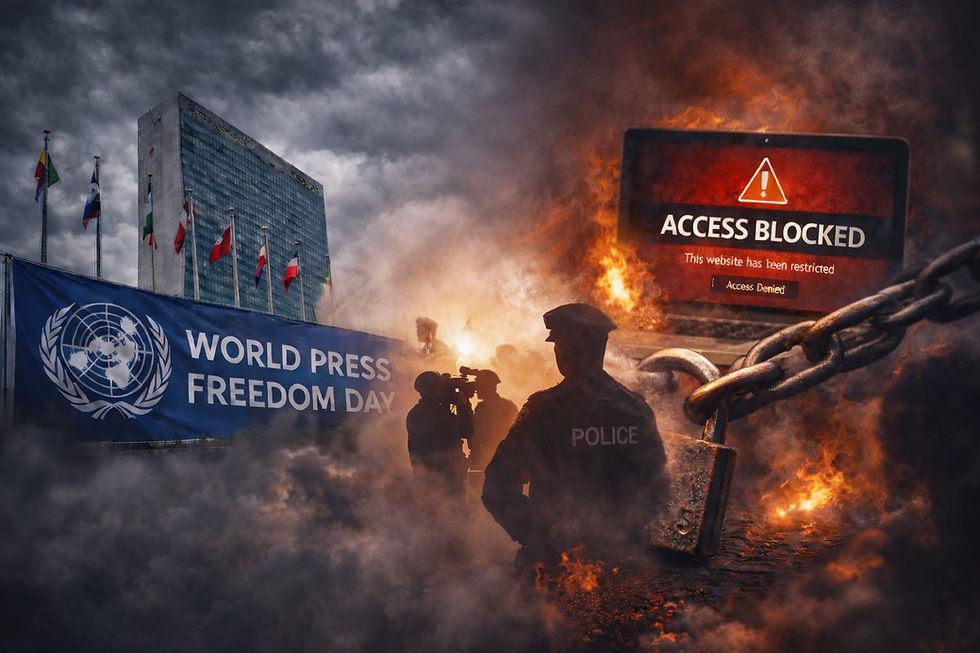
That space is increasingly online, where audiences read, watch, share, argue, and react in real time; where websites are blocked; where legal language can be turned into a weapon; where intimidation moves faster than reporting; and where economic weakness can quietly work like censorship without the drama of a formal ban.
RSF warned in its 2025 World Press Freedom Index that economic pressure has become a major and increasingly “insidious” threat to media freedom worldwide, including in MENA.
This shift has changed the meaning of press freedom itself. The question is no longer only whether a journalist is technically allowed to publish. It is whether independent voices can still function, reach audiences, verify facts, challenge power, and remain visible in the spaces where public debate now actually happens. That is why the issue fits squarely within the logic of SDG 16.10, which calls on states to “ensure public access to information and protect fundamental freedoms.”
Egypt deserves particular attention because it is a North African country, the most populous Arabic-speaking country in the world, and one of the MENA region’s central media, political, and cultural reference points. What happens in Egypt usually spreads beyond its borders. Its scale imparts it regional weight. Its media legacy provides it wider influence. And its digital environment offers one of the clearest examples of how old and new forms of restriction can merge.
In Egypt, the issue is not only whether journalism exists. It is whether it can still reach the public in meaningful ways. An outlet may publish, but if readers inside the country cannot easily access it, the problem is no longer censorship in the old sense alone. It becomes control through restriction and isolation.
RSF says outlets that refuse to submit to censorship are blocked, citing Mada Masr as inaccessible in Egypt since 2017. CPJ reported in 2025 that Egypt blocked the Brussels-based outlet Zawia3, underscoring continued pressure on independent media.
That matters beyond the profession itself. When access narrows, participation narrows with it. Some voices remain better protected, better connected, or better funded than others. Others become easier to marginalize and to push out of view. That is where the press-freedom argument meets SDG 10. Inequality is not only economic. It is also about unequal access to visibility, legal protection, information, and public participation.
Elsewhere in the region, the pattern changes form but not effect.
In Iraq, RSF says constitutional guarantees for press freedom are contradicted by existing laws and repeated cybercrime proposals. Freedom House reported that internet freedom in Iraq declined during its latest assessment period, with website blocking and prison sentences tied to online expression.
Tunisia shows a more procedural form of pressure. CPJ reported in January 2025 that Tunisia had a record number of jailed journalists, many imprisoned under Decree-Law 54, a cybercrime law increasingly used against reporting and commentary. There, the process itself has become both punishment and warning.
Lebanon presents a more fractured model. Pressure on journalism comes not from one centralized censor but from conflict, insecurity, economic collapse, and legal harassment hitting at once. In March 2025, CPJ joined dozens of media and rights groups in defending Daraj and Megaphone amid what it called intensifying legal harassment. RSF has also warned that political and financial pressure continue to weigh heavily on Lebanese media.
Taken together, these cases demonstrate that press freedom in MENA can no longer be understood through a single old template. The common thread is digital space. That is where journalism now circulates, where intimidation moves fastest, and where law reaches more deeply into daily expression. That is also why the issue increasingly touches SDG 9, especially where access to information and communications systems shapes who can enter public debate and who is fenced out of it.
Article 19 of the Universal Declaration of Human Rights protects the right to “seek, receive, and impart information and ideas through any media and regardless of frontiers.” In MENA today, that principle tests itself not only in courtrooms and ministries but also across the digital infrastructure of public life.
World Press Freedom Day still matters. But in MENA, its meaning has changed. The central question is no longer only whether journalists can publish. It is whether journalists, broadcasters, editors, and independent media can still work, verify facts, challenge authority, and remain heard inside a public sphere shaped by pressure that now moves at the speed of the internet. That is a press-freedom issue. It is also an SDG 16 issue of rights and institutions, an SDG 10 issue of unequal participation, and increasingly an SDG 9 issue of who can actually access the infrastructure through which modern public life now runs.
**About the Author: Ahmed Fathi is an internationally syndicated journalist, United Nations correspondent, global affairs analyst, and human rights commentator. He writes about diplomacy, multilateralism, power, public freedoms, and the politics shaping our global future.